Growth is supposed to feel good.
More revenue, more customers, more people on the team — that’s the plan working. So why does it feel like drowning?
Here’s the pattern I see over and over in growing businesses: the company doubles, but the way it operates stays the same. Same informal processes. Same decisions routing through the same one or two people. Same systems that were built — usually improvised — when the whole team fit around one table. Growth doesn’t break these businesses. It just reveals what was always going to break.
The tricky part is that operational strain rarely announces itself as an operations problem. It shows up disguised as a people problem, a time problem, or just “how things are at our size.” So here are the five signs worth taking seriously — and what each one actually looks like on an ordinary Tuesday.
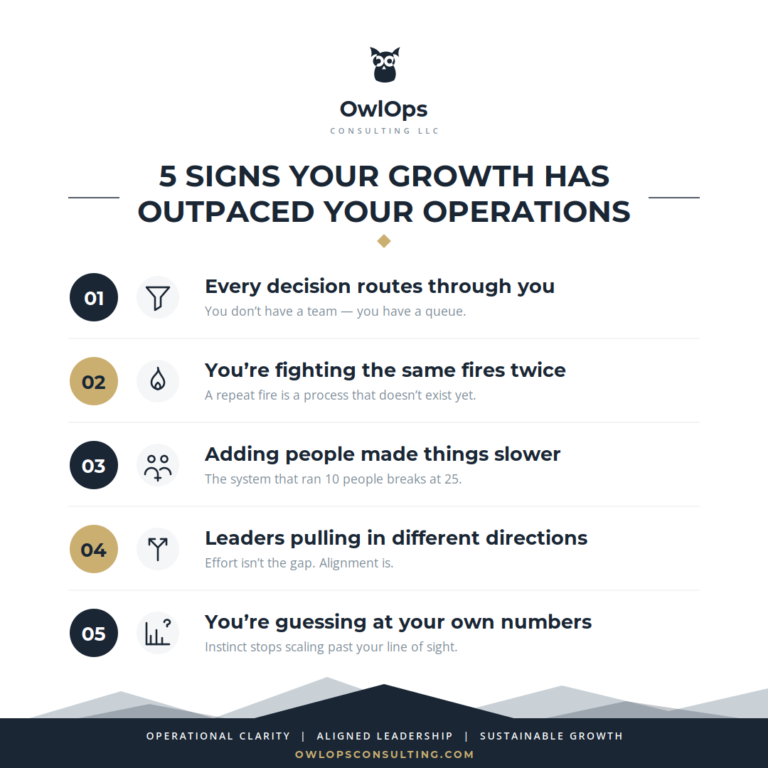
1. Every Decision Still Routes Through You
On paper, you have a team. In practice, you have a queue.
Pricing exceptions, hiring calls, customer escalations, which vendor to use, whether to order the thing — it all waits for you. When you’re in the building, work moves. When you take a real vacation (remember those?), it piles up or stalls.
What it looks like on a Tuesday: you open your laptop to do strategic work and instead spend four hours answering questions that each take three minutes — questions your team could answer themselves if the decision rights, priorities, and guardrails were actually defined anywhere.
This isn’t a delegation character flaw. It’s a structure gap: when there’s no documented way to decide, the owner becomes the way to decide.
2. You’re Fighting the Same Fires Twice
Every business has fires. Growing businesses with operational gaps have reruns.
The same order mistake as last quarter. The same onboarding stumble with the new hire that you had with the last one. The same end-of-month scramble, every single month, that everyone treats as weather — unpleasant, unavoidable, nobody’s fault.
A fire that happens once is an incident. A fire that happens twice is a process telling you it doesn’t exist. When workflows are inconsistent, ownership is unclear, and nothing is documented, fixes live in individual memories — so the fix leaves when the person is out sick, busy, or gone.
3. Adding People Made Things Slower
This is the sign that shocks owners the most, because it inverts the whole logic of hiring. You brought on more people to get more done — and somehow coordination got harder, quality got less consistent, and your own workload went up.
What it looks like on a Tuesday: your newest hire is six weeks in and still asking how things work, because “how things work” isn’t written down anywhere — it’s apprenticed, one interruption at a time, from people who are already stretched.
Ten people can run on shared context and hallway conversations. Twenty-five can’t. Past a certain size, the informal operating system that got you here stops scaling, and every new person multiplies the confusion instead of the capacity. The tools and processes built for a smaller company begin breaking down as teams, customers, and complexity increase — right on schedule.
4. Your Leadership Team Is Rowing Hard — in Different Directions
Nobody’s slacking. That’s what makes this one so frustrating. Sales is chasing one kind of customer, operations is built for another, and the priorities discussed in January quietly dissolved by March because nothing turned them into commitments with owners and dates.
What it looks like on a Tuesday: a leadership meeting that’s ninety minutes of status updates, zero decisions, and a vague agreement to “circle back” — followed by everyone returning to their department’s version of what matters.
Vision isn’t the problem; most owners have plenty. The gap is the machinery that turns vision into execution: a real planning rhythm, shared priorities, numbers everyone actually looks at, and accountability that doesn’t depend on anyone’s mood.
5. You Can’t Answer “How’s the Business Doing?” Without Guessing
You know revenue, roughly. Beyond that — margins by service line, team capacity, where jobs are getting stuck, whether this month is actually better than last — the honest answer lives somewhere between your bookkeeper, three spreadsheets, and your gut.
Operating on instinct works at a size where you personally see everything. Growth ends that. Once the business is bigger than your line of sight, decisions made without real numbers aren’t judgment anymore — they’re coin flips with confidence.
If you don’t have a handful of KPIs you trust and review on a rhythm, you’re not managing the business. You’re managing your impression of it.
Why This Happens to Good Operators
Notice what’s not on this list: lazy teams, bad hires, a broken business model. If several of these signs hit home, the natural instinct is to blame effort or talent — work harder, hire better, push more.
But these are infrastructure problems, not effort problems. Everything on this list traces back to the same root: the business grew, and its operating system didn’t. Processes, decision rights, planning rhythms, and reporting are infrastructure — and infrastructure has to be deliberately rebuilt at each new stage of growth. Nobody tells owners this. You were busy growing the thing.
The good news is that infrastructure problems are the fixable kind. They respond to structure, sequence, and follow-through — not heroics.
What to Do Next
If one sign resonated, keep an eye on it. If three or more did, your growth has outpaced your operations, and more effort inside the current system will only buy you months, not years.
Start by getting honest about the gap: pick your worst recurring fire and trace it to the missing process underneath. Define who owns which decisions, so your team stops queuing behind you. And put three numbers — just three — in front of your leadership team every week.
And if you want experienced help, that’s exactly the gap a fractional COO fills — executive operations leadership, without the full-time hire. I wrote a plain-language guide to what a fractional COO actually does (and whether you need one), and you can see how OwlOps approaches this work — including our six-step method — on our services page.
Or skip straight to a conversation: schedule a discovery call. Thirty minutes, no pitch. You tell us where growth is creating friction, and you’ll leave with a clearer view of your operations — whether or not we ever work together.
Leo Rondeau is the founder of OwlOps Consulting, a Phoenix-based firm providing fractional COO and operations consulting services to growing small and mid-sized businesses.