Somewhere out there is a business owner who read Traction, got genuinely fired up, rolled out EOS® with the whole team — rocks, scorecards, Level 10 meetings, the works — and eighteen months later is quietly wondering why the company still feels stuck.
I’ve met a lot of that owner. Sometimes the diagnosis is complicated. Usually it isn’t:
The Integrator seat is empty. Or worse — the Visionary is sitting in it.
A Quick Level-Set (Skip Ahead if You Run EOS)
EOS — the Entrepreneurial Operating System — is a framework thousands of small and mid-sized businesses use to run themselves: a shared vision, a handful of numbers everyone watches, quarterly priorities called rocks, and a disciplined meeting rhythm that keeps it all moving.
At the top of the EOS model sit two seats. The Visionary — usually the founder — generates ideas, drives big relationships, and sees where the company should go. The Integrator runs the business: turning the vision into plans, managing the leadership team, resolving cross-department conflict, and making sure what got decided actually gets done.
The framework is honest about something many owners learn the hard way: these are two different jobs, wired for two different kinds of people, and one person holding both seats holds neither one well.
Why “We Run EOS” and “We’re Stuck” Happen Together
EOS gives you the operating system. It does not give you the operator.
The tools work — but tools don’t run themselves. Rocks get set and quietly die by week six because nobody is managing the follow-through. Level 10 meetings drift back into status updates. The scorecard exists, but when a number goes red two weeks running, no one owns the response. Issues get listed faithfully and solved never.
Every one of those breakdowns is the same breakdown: the system is installed, but the Integrator seat — the seat accountable for making the system produce results — is vacant, part-time, or occupied by a Visionary who would rather be doing literally anything else. If that’s compounding the broader symptoms I wrote about in 5 Signs Your Growth Has Outpaced Your Operations, the seat is almost certainly your bottleneck.
Three Roles People Mix Up
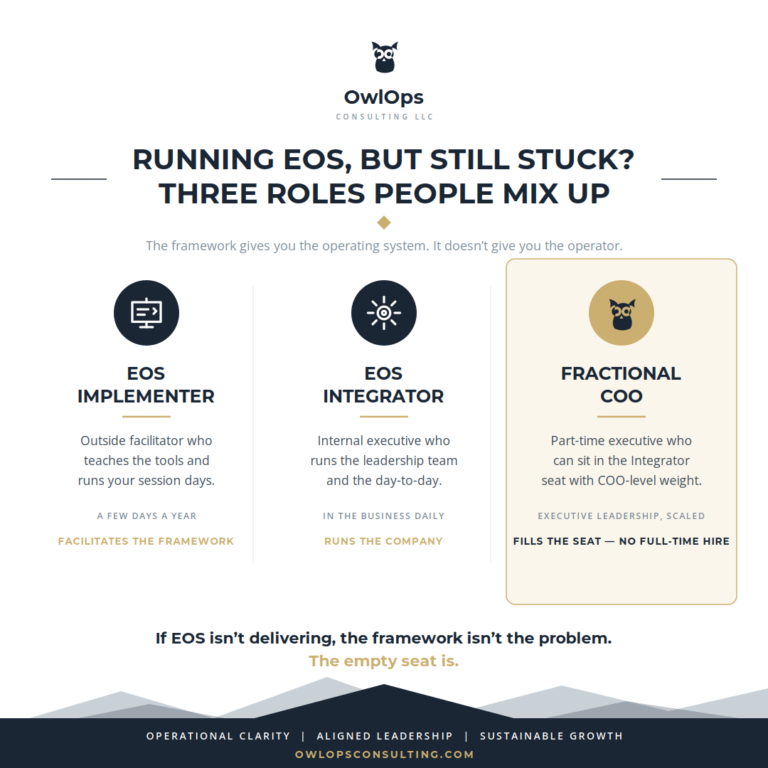
Part of the confusion is vocabulary, because three distinct roles get blended together in these conversations.
The EOS Implementer
An Implementer is an outside facilitator who teaches your leadership team the EOS tools and runs your session days — typically a handful of full-day sessions per year. A good one is valuable. But the Implementer’s job ends where daily operations begin: they facilitate the framework; they don’t run your company between sessions. Many stuck-while-running-EOS businesses have a great Implementer and still no one running the system Tuesday through Friday.
The Integrator
The Integrator is an internal executive — in most companies, this is the COO by another name. They’re in the business every day: leading the leadership team, driving rock completion, forcing decisions on the issues list, and gluing departments together. This is an operating role, not a facilitating one.
The Fractional COO
A fractional COO is an experienced operations executive who works inside your business part-time, carrying real ownership of how the company runs. Which means a fractional COO can sit in the Integrator seat — bringing the executive weight the seat demands, at a scale a growing company can actually afford.
So Which One Do You Need?
It depends on which gap you actually have. A few honest rules of thumb:
- You’re new to EOS and want to install it properly: start with implementation — the framework taught and facilitated well. (This is one of the services OwlOps provides under our strategic leadership pillar.)
- You run EOS, but execution dies between session days: your gap is the Integrator seat, not the framework. More facilitation won’t fix an operating vacancy.
- You have a strong internal candidate for Integrator: promote them — and consider fractional COO support to coach them into the seat rather than throwing them in cold. Integrator is usually a bigger jump than it looks from below.
- You need the seat filled now, but a full-time executive isn’t realistic yet: that’s the textbook case for a fractional COO as Integrator — the seat gets real executive experience immediately, and you buy time to grow into (and hire well for) the full-time version later.
What I Learned Running EOS from the Integrator Seat
This topic isn’t theoretical for me. As COO at Colling Media, I ran operations through an EOS integration — executing the CEO’s vision and translating it into an operating rhythm the whole company could run on. Three lessons from that seat that I bring into every OwlOps engagement:
The magic isn’t the tools — it’s the follow-through. Any team can set rocks in a planning session while the coffee’s still warm. The companies that transform are the ones where someone chases those rocks in week three, week seven, and week eleven, when the enthusiasm is gone and the day-to-day is loud. That someone is the Integrator. Without them, EOS is a very organized wish list.
The Visionary-Integrator relationship is the whole ballgame. When it works, the Visionary gets the freedom to do what only they can do, precisely because someone they trust is running the machine. When it doesn’t, every disagreement leaks down into the leadership team as mixed signals. Protecting that relationship — same page, always — is as much the job as any scorecard.
The system has to outlive its operator. The Integrator’s real deliverable isn’t this quarter’s rocks. It’s a leadership team that decides well, a cadence that holds, and processes that don’t depend on any one person — including the Integrator. That’s the standard I hold OwlOps engagements to: the goal is a business that runs well, not a business that acquired one more dependency.
The Bottom Line
If EOS isn’t delivering, resist the instinct to blame the framework or your team. First ask the sharper question: who is running this system every day — really? If the honest answer is “no one” or “me, in the cracks between everything else,” the framework was never the problem. The seat was.
If you’re weighing how to fill it — implementation, an internal promotion, or a fractional COO in the Integrator seat — that’s exactly the kind of question a discovery call is for. Schedule one here: thirty minutes, no pitch, and you’ll leave knowing which gap you actually have. That alone is worth the half hour.
Leo Rondeau is the founder of OwlOps Consulting, a Phoenix-based firm providing fractional COO and operations consulting services — including EOS implementation — to growing small and mid-sized businesses.
EOS® and Entrepreneurial Operating System® are registered trademarks of EOS Worldwide. OwlOps Consulting references the framework based on hands-on operating experience.